 Zkswap
 token swaps, liquidity pools, and rewards
Last updated
Zkswap is a decentralized exchange combining classic, concentrated, and stablecoin liquidity pools with routing tools and trading incentives. Traders exchange tokens against deposited liquidity, while providers earn a share of pool fees. Classic deposits receive fungible pool shares; concentrated positions use selected price ranges and individual non-fungible tokens (NFTs). Routing connects these pool designs, and ZAP handles token balancing during liquidity changes. The chosen network determines which assets and contracts the transaction uses.
A concentrated liquidity position earns swap fees from trades within its selected price range, so range choice affects fee participation.
Can one swap use several liquidity pools?
A single swap can use liquidity from several pools through the Universal Router. It searches across classic V2 automated market makers (AMMs), concentrated V3 pools, and Stableswap. A route can split the trade among pools when their combined pricing improves the quoted output. The pools supply the tokens; the router determines how those pools contribute to execution.
Aggregator extends route discovery across multiple decentralized exchanges and liquidity sources. Its routing technology uses Odos. That broader search still relies on liquidity available for the selected assets and network. A quoted route reflects pool conditions at quotation, while execution faces the conditions when the transaction runs.
Trading uses a connected non-custodial wallet to interact with the exchange’s contracts. The wallet identifies the account, while each contract governs its own operation. Token approvals can grant spending permissions, which are a separate authorization from merely connecting the wallet.
Classic and concentrated pools commit liquidity differently
Classic V2 pools accept equal-value deposits of their two tokens and issue fungible liquidity provider (LP) tokens. Equal value does not require an equal number of token units. The LP balance represents a proportional pool share, which can also become the input for a corresponding farming program.
Trading changes the pool’s reserves and the composition of its assets. A pool share therefore does not preserve the original token quantities.
Concentrated V3 pools let each provider select the price interval where their liquidity participates. Each concentrated liquidity position is represented by a unique NFT. The range is part of the position, so deposits in the same pool can behave differently. Capital efficiency describes how much liquidity supports trading near a price; it does not establish a fixed return.
When price leaves a selected interval, that position stops supplying active liquidity and earning swap fees until price reenters. A narrower interval focuses liquidity around fewer prices and can require closer management. Both designs expose providers to relative token price changes. A position can become worth less than holding the deposited tokens separately, a difference called impermanent loss.
Stableswap pricing depends on closely pegged assets
Stableswap on ZKsync Era uses a pricing curve designed for assets trading near a shared reference value, including stablecoins. It combines constant-sum and constant-product relationships to reduce trading friction near that peg. Its usefulness rests on the assets remaining closely priced and sufficient liquidity being present. A pricing formula does not maintain an issuer’s peg. If an asset departs from that reference, the pool can experience imbalance, and providers retain exposure to that asset.
ZAP connects token balancing with liquidity changes
ZAP combines the swaps needed to balance pool tokens with adding or removing liquidity in one transaction.
For classic pools, it accepts uneven starting proportions of the pool’s two tokens. The balancing swap produces the equal-value composition required by that pool, and the liquidity deposit returns LP tokens. This changes how a deposit is funded without changing the pool’s underlying AMM model.
For concentrated pools, ZAP matches the inputs to the selected price range and resulting token ratio. It uses the integrated aggregator for route simulation and checks pool conditions again on-chain. The required token proportions can change as the pool price moves. The deposit must match those conditions at execution.
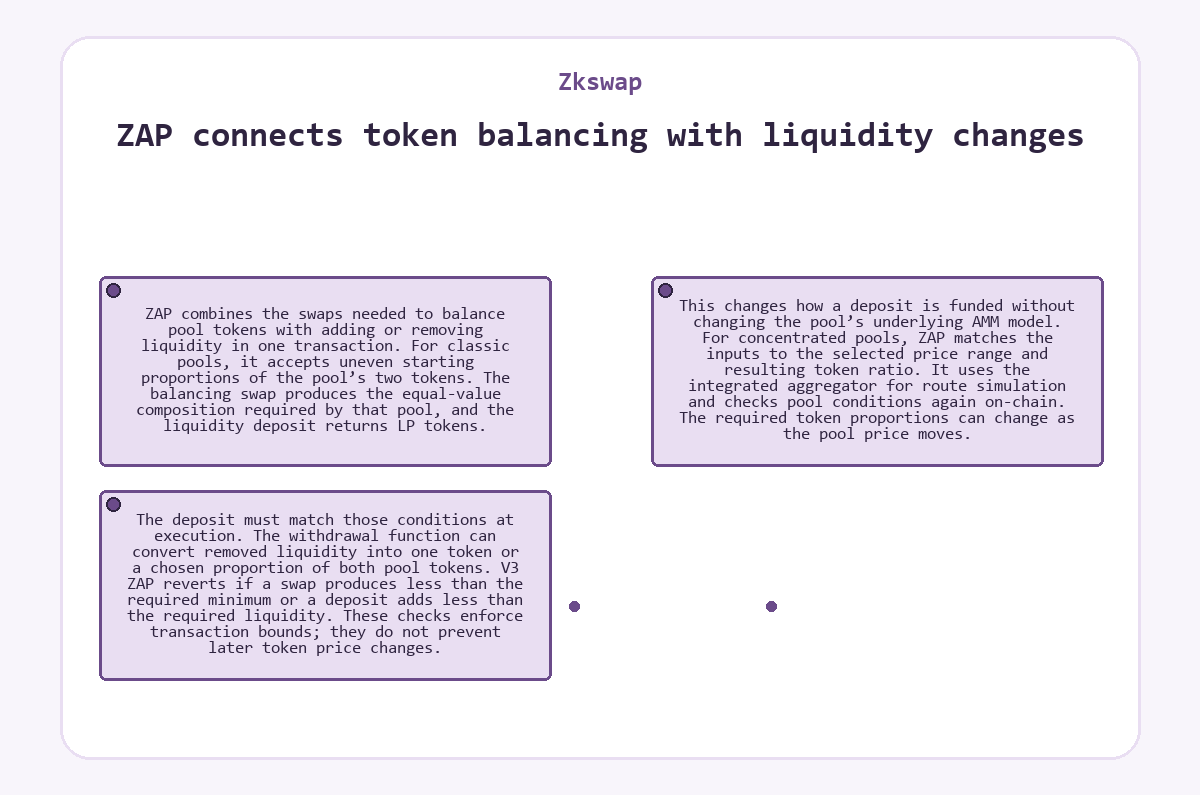
The withdrawal function can convert removed liquidity into one token or a chosen proportion of both pool tokens. V3 ZAP reverts if a swap produces less than the required minimum or a deposit adds less than the required liquidity. These checks enforce transaction bounds; they do not prevent later token price changes.
Pool fees and gas pay for different parts of execution
The pool fee belongs to the trade’s pricing, with portions allocated to liquidity providers and the protocol. Gas pays for transaction execution on the blockchain. A lower pool fee cannot establish a lower total cost without considering the route, output, and execution charge.
The concentrated-pool fee schedule pairs its 0.04% tier with a 66% provider share and a 34% protocol share. These percentages divide the fee, not the entire traded balance. Configured rates and allocations can change; classic and Stableswap pools have separate schedules. On ZKsync Era, ZF Paymaster provides a supported-token payment mechanism for gas.
Trading rewards and farming depend on different contributions
Swap2Earn rewards qualifying trading participation, while Farm2Earn adds incentives to eligible liquidity positions. Swap2Earn uses registration, activity points, and cycle-based distribution. A participant’s share depends on their points relative to total cycle points and the rewards assigned to that cycle. Trading volume alone therefore does not fix a payout.
Farm2Earn adds a staking condition to liquidity provision. Classic LP tokens can enter a corresponding farm, and farming support also extends to concentrated positions. Earning pool fees and receiving farming emissions are separate mechanisms. A liquidity deposit does not, by itself, complete an additional farm staking requirement.
DuoEarn combines campaign-specific ZK and ZF incentives with trading fees for designated liquidity positions. Eligibility belongs to the particular campaign and pool. A reward schedule does not protect deposited assets from price changes, and the market value of rewards can move independently.
Network selection determines the assets and contracts
Separate contract deployments on ZKsync Era, Sonic, and Monad place swaps and liquidity in distinct network environments. The token balance used for an action must exist on the network where its contracts execute. Matching wallet addresses across networks do not combine those balances.
Zkswap announced Monad testnet support on April 15, 2025, covering swaps and both classic and concentrated liquidity. That environment used test assets from a faucet. The announcement concerned a testnet deployment; it did not establish mainnet availability on that date.
Bridge supports transfers between networks, while its fiat onramp uses Onramper. Its transfer integrations include Socket and Owlto. These services address funding and movement between chains, separate from a pool’s internal token pricing. A bridge route and a pool swap can have different assets, fees, and completion conditions.
Governance and asset tools extend the exchange
ZF also connects trading incentives with governance participation. On ZKsync Era, staking it in the DAO Staking Pool creates yZF shares with voting power. Those shares can also affect Swap2Earn boosting. For core proposals, voting results serve as a reference for the team’s implementation decisions.
Portfolio displays holdings, asset distribution, and trading information for ZKsync Era. It also converts small token balances.
Revoke exposes approved spenders and provides permission management. Those permissions concern what a contract can spend from a wallet. They are distinct from the wallet’s displayed balance and from liquidity that has already been deposited into a pool.
Tokenize NFT connects ERC-721 collectibles with ERC-20 tokens that can participate in token markets. Depositing NFTs creates fungible representations, and redemption burns whole tokens for deposited NFTs. This wrapping function differs from the NFT that records a concentrated liquidity position, even though both involve non-fungible tokens.
Which liquidity setup matches the assets you want to supply?
The appropriate setup follows from the assets’ price relationship, the desired price coverage, and the form of the position.
- Classic pools combine equal-value token deposits with fungible pool shares and liquidity across the price curve.
- Concentrated pools require a selected price range and represent the deposit with an individual position NFT.
- Stableswap applies specialized pricing to closely pegged assets while their shared-price relationship holds.
- ZAP handles uneven token proportions within its supported deposit and withdrawal operations.
- Additional farming rewards depend on the selected pool’s eligibility and any required farm staking.
A classic deposit avoids selecting an interval. Concentrated liquidity adds control over price coverage, together with responsibility for managing that range.
Worth knowing
Is yZF issued one-for-one with deposited ZF?
yZF issuance follows the DAO Staking Pool’s share ratio on ZKsync Era, so one deposited ZF does not necessarily mint one yZF. The amount received equals deposited ZF multiplied by outstanding yZF supply, divided by the pool’s total ZF before the deposit.
When can ZF Paymaster replace ETH as the gas payment token?
ZF Paymaster supports paying swap gas with accepted tokens on ZKsync Era when that payment option is selected. ZF is among the supported payment tokens. Paying gas in another token still involves a gas charge; sponsored swap gas has separate eligibility conditions.
What can revoke change after a token approval?
Revoke can remove a spender’s token permission on a supported network. Its spender list concerns authorizations granted by the connected wallet. Removing an approval changes that spending permission; it does not reverse a completed swap or withdraw assets already supplied to a liquidity pool.
Which tokens can Portfolio’s small-balance conversion produce?
Portfolio includes a function for converting small token balances into ZF and LONG on ZKsync Era.
Does token whitelisting imply that the asset has been endorsed?
Token whitelisting does not constitute endorsement by the exchange. Whitelisting follows platform criteria, and the platform can modify or revoke that status. A whitelisted token can still carry risks. Its inclusion does not establish price stability, backing, or protection against losses.
What determines which NFT a tokenization redemption returns?
Tokenize NFT returns deposited NFTs in first-in, first-out order when whole wrapper tokens are burned. Tokenization issues one ERC-20 token per NFT. Redemption follows the deposit order for the selected wrapper, so holding its fungible tokens does not give the holder a choice of any particular NFT.